It was common knowledge in Makkah
and Madinah that Abul Hakam Umar bin Hishaam (Abu Jahl) was planning an attack
against the Muslims. He incited the Quraish to avenge the death of Amr bin
al-Hazramee at Nakhla.
An Islamic blog with scriptural teachings on topical islamic issues based on verdicts from Quran, Hadith, Fiqhiu, Fatwah and thorough researches. Inspiring stories, Islam in history, Islamic Videos and cartoons for Kids, Questions and answers, Current Affairs and News
Showing posts with label HISTORY OF ISLAM. Show all posts
Monday, December 22, 2014
Sunday, November 16, 2014
Islam Story: The People of the Cave In surah Al-Kahf
Allah the Almighty says: {Do you think that the people of the Cave and the Inscription (the news or the names of the people of the Cave) were a wonder among Our Signs? (Remember) when the young men fled for refuge (from their disbelieving folk) to the Cave. They said: "Our Lord! Bestow on us mercy from Yourself, and facilitate for us our affair in the right way!" Continue after the cut... |
Saturday, November 8, 2014
Minaret of Prophet Isa (upon him be peace)
This
minaret, which is on the left side of the Umayyad Mosque is also known as the
Jesus minaret. It is from here that Hazrat Isa (upon him be peace) will descend
back to earth towards the end of time.
Friday, November 7, 2014
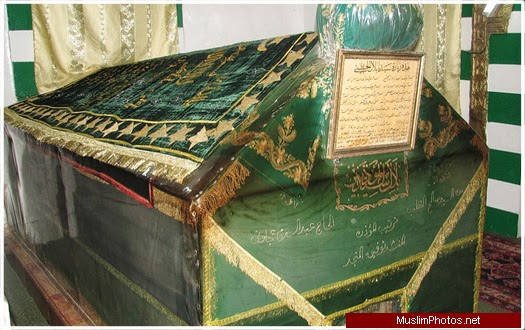
Tomb of Bilal (may Allah be pleased with him)
This is the tomb of Bilal-bin-Rabah
(may Allah be pleased with him), one of the best known of the galaxy of Sahabah
as the Muezzin (caller to prayer) of the Prophet’s Masjid. It is located in the
Bab al-Saghir cemetery in Damascus.
Thursday, November 6, 2014
Resting place of the Ark of Prophet Nuh (upon him be peace)
Mount Judi is the resting place of the
Ark built by Nuh (upon him be peace) by the command of Allah. It is situated in
south-east Turkey, close to the Syrian and Iraqi borders. The Quranic account
of the Flood and Noah’s Ark agrees with that given in the Bible, with a few
variations. One of these concerns the final resting place of the Ark. According
to Genesis, the Ark grounded on the “mountains of Ararat”; while according to
Surah 11:44 of the Qur’an, the final resting place of the vessel was called Mount
Judi:
Tomb of Prophet Shoayb (upon him be peace)
This tomb is believed to be that of
Shoayb (upon him be peace). He is regarded as being the father-in-law of Musa (upon
him be peace) and was sent to the people of Madyan, a community of merchants
who controlled the great trade routes between Yemen and Syria, and between Iraq
and Egypt on the shores of the Red Sea.
Continue after the cut...
Wednesday, November 5, 2014
Cave of Ashabe-Kahf (interior)
The
main view above shows a section of the interior. The crafted stone blocks are
tombs; one of them has a viewing hole through which bones can be seen (inset).
The bones of the dog have also been displayed.
Cave of Ashabe-Kahf (exterior)
This
is regarded as the cave in which a group of pious youths (equated with the
Christian legend of the ‘Sleepers of Ephesus’) sought refuge from a tyrannical
pagan king and in which Allah (Glorified and Exalted is He) caused them to
sleep for 300 years. Their story is mentioned in the Holy Quran in Surah Kahf. The
cave is located in the suburb of Abu Alanda in Amman.
Tuesday, November 4, 2014
Body of Fir’awn (Pharaoh)
This
is the body of Fir’awn (Rameses II), believed to be the Pharoah in the time of
Musa (upon him be peace). His mummy is preserved and is currently on display in
the Royal Mummies Chamber in Cairo Museum, Egypt.Continue after the cut...
Memorial to Imam Bukhari
This
memorial complex, near Samarkand in Uzbekistan houses the grave of Imam
Bukhari, most well known for authoring the hadith (sayings of the Prophet)
collection named Sahih Bukhari, regarded as the most authentic of all hadith
compilations and the most authoritative book after the Quran.
Masjid al-Aqsa (Bayt al-Maqdis)
Masjid al-Aqsa is not only the Qibly
mosque (with the silver/black dome) or the Dome of the Rock. It is in fact the
whole region highlighted above and is also known as Bayt al-Maqdis or Bayt
al-Muqaddas (House of the Holiness). The name ‘Masjid al-Aqsa’ translates
as ‘the farthest mosque’ and is the third most holy place in Islam. It was here
that in around 621 CE the Prophet Muhammed (peace and blessings of Allah be on
him) came on the night journey from Makkah riding on the Buraq.
The city of Makkah
Makkah
is the blessed city which is the most beloved land in the sight of Allah
(Glorified and Exalted is He) and the chosen location of His House. It was here
that the final prophet and guide of the whole of mankind, Muhammad (peace and
blessings of Allah be on him), was born and commenced his Prophethood.
- Allah (Glorified and Exalted is He) has called Makkah by five names in the Quran: Makkah, Bakkah, Al-Balad, Al-Qaryah and Ummul-Qura.
- In Surah Al-Imran, Allah (Glorified and Exalted is He) states: “Verily, the first House (of worship) appointed for mankind was that at Bakkah (Makkah), full of blessing, and a guidance for Al-Alamin (mankind and jinn).” [3:96]
- When the Muslims conquered Makkah. The Prophet (peace and blessings of Allah be on him) said,“Allah had made this city sacred the day He created the heavens and the earth and it’s sanctity shall remain until the Day of Qiyamah (Day of Judgement). Its thorns cannot be broken, its animals cannot be harmed and things fallen on its ground cannot be picked up unless with the intention of returning it to its owner or making public announcements (to locate the owner). It is also forbidden to cut the grass that (naturally) grows here.” [Muslim]
- The reward of prayer offered in Masjid al-Haram is multiplied many times. Jabir bin Abdullah (may Allah be pleased with him) narrates that the Prophet (peace and blessings of Allah be on him) said:“A prayer in this mosque of mine is better than one thousand prayers anywhere else, except for al-Masjid al-Haram. A prayer in al-Masjid al-Haram is better than one hundred thousand prayers (anywhere else).” [Ahmad]
- The Prophet (peace and blessings of Allah be on him), sitting on his camel in the Al-Hazwarah market, addressed Makkah saying, “By Allah, you are the best land of Allah, the most beloved land of Allah to Allah. Had I not been driven out of you, I would not have left you.” [Zaadul Ma’aad]
- The Prophet (peace and blessings of Allah be on him) once remarked: “There is no city in which Dajjal will be unable to enter besides Makkah and Madinah. Every street will be lined with angels standing in rows to protect them.” [Bukhari]
The city of Madinah
Madinah
Munawarrah (“the enlightened city”) ranks as the second most holiest place in
Islam after Makkah. It is the city that gave refuge to the Prophet Muhammad
(peace and blessings of Allah be on him) and the early Muslims upon their
migration from Makkah and where lies the burial place of the Prophet (peace and
blessings of Allah be on him).
- The city of Madinah was originally known as Yathrib, an oasis city dating as far back as the 6th century BCE. During the war between Jews and Romans in the third century CE, many Jews fled Jerusalem and migrated to their ancestral place of Yathrib (present Madinah). Nero sent a massive Roman force under Petra Lenidas to Madinah to massacre the Jews in 213 CE. A community survived and by the time the Prophet (peace and blessings of Allah be on him) had migrated there was a large Jewish presence around the city.
- The Jews were eagerly waiting for the arrival of a prophet who, according to their scriptures, would appear in Madinah. They used to taunt the local Arabs that when he did arrive, according to their prophesies, the Jews would destroy the pagans as the ancient people of Aad and Thamud had been destroyed for their idolatry. However, when they realized that the final prophet was chosen among the Arabs rather than from the Jews their pride got the better of them and they rejected him even though as the Quran mentions (in 2:146) they recognized him as they recognize their sons. In spite of this, there were some Jews who embraced Islam, most notably Hussain bin Salam, one of their most learned Rabbis. The Prophet (peace and blessings of Allah be on him) changed his name to Abdullah bin Salam.
- The city of Madinah was not unfamiliar to the Prophet (peace and blessings of Allah be on him) when he emigrated there. His father Abdullah was buried there and when he was six years old he had travelled with his mother Aminah and their devoted slave girl Barakah (later to be known as Umme Ayman). In later life he recounted how he had learned to swim in a pool which belonged to his kinsmen with whom they had stayed, and how the boys taught him to fly a kite. However, not long after they had set out for the return journey his mother fell very ill, and died a few days later at Abwa, not far from Yathrib where she was buried. Barakah did what she could to console the boy, now doubly an orphan and brought him back to Makkah.
- About a year before the migration, the Prophet (peace and blessings of Allah be on him) had dispatched Mus’ab bin Umair (may Allah be pleased with him) on a mission to propagate Islam (Tableegh) to the people of Madinah. Many of the Ansar became Muslims at his hands.
- Madinah is 210 miles (340 km) north of Makkah. At the time of the Prophet (peace and blessings of Allah be on him), Madinah was approximately the size of the present masjid and the surrounding white tiled area.
Masjid Quba
Quba
is the place on the outskirts of Madinah where the Prophet (peace and blessings
of Allah be on him), accompanied by Abu Bakr (may Allah be pleased with him)
arrived and first stayed after emigrating from Makkah. They arrived on Monday
12th Rab’i al-Awwal, fourteen years after Prophethood and this date marks the
beginning of the Islamic calendar (Hijra), (16th July 622 CE). A masjid was
established here by the Prophet (peace and blessings of Allah be on him), the
first to be built in Islam.
- The virtue of Masjid Qubas is mentioned in the following Quranic verse in Surah Taubah: “…certainly a masjid founded on piety from the very first day is more deserving that you should stand in it…” [9:108]
- The Prophet (peace and blessings of Allah be on him) said: “He who purifies himself at his home and comes to Masjid Quba and offers two rakats therein, will be rewarded the reward of an Umrah (lesser pilgrimage).” [Sunan ibn Majah]
- The people of Yathrib (which was later named Al-Madinah Al-Munawwarah, the Enlightened City) had long awaited the Prophet (peace and blessings of Allah be on him), and each day they would go beyond the fields and palm groves and wait for him until the sun became unbearable. One day the people returned to their homes after waiting a long time for the Prophet. A Jew happened to catch a glimpse of a small group of white-robed travellers in the distance. He called out: “O people of Arabia! What you have been waiting for has arrived!”
- The Muslims lifted their weapons and rushed to greet the Prophet (peace and blessings of Allah be on him). There was a great clamour as everyone ran to the edge of the desert to catch a glimpse of the travellers. The Prophet (peace and blessings of Allah be on him) then turned toward the right and came to Banu Amr bin Auf at Quba. Most of the Muslims who had emigrated from Makkah had stayed at Quba and many of them were there when the Prophet (peace and blessings of Allah be on him) arrived.
- After reaching Quba, the Prophet (peace and blessings of Allah be on him) dismounted. Those of the Ansar (literally meaning ‘the helpers’, the name given to those in Al-Madinah who became Muslim) who had not seen the Prophet (peace and blessings of Allah be on him) thought that Abu Bakr (may Allah be pleased with him) was the prophet because his hair had grown a little gray. But when they saw Abu Bakr shade the Prophet (peace and blessings of Allah be on him) with a sheet, they realized their mistake.
- It was a time of great joy from both sides. The Prophet (peace and blessings of Allah be on him) addressed them saying: “O People, give unto one another greetings of peace; feed food unto the hungry; honour the ties of kinship, pray in the hours when men sleep. Even so shall ye enter paradise in peace.”
- On arriving in the village of Quba after the blessed Hijra (migration), the Prophet (peace and blessings of Allah be on him) stayed for several days in the house of Kulthoom bin Hadm (may Allah be pleased with him) and laid the foundations of Masjid Quba on his land. Prior to the migration of the Prophet (peace and blessings of Allah be on him) the Muslims sometimes offered their Friday prayers at the house of Sa’ad ibn Khaithamah (may Allah be pleased with him) which was close by. The location of this house was included in the modern day extension of Masjid Quba but the location of the house of Kulthoom bin Hadm (may Allah be pleased with him) is marked by a few boulders to the south-west of Masjid Quba.
Islamic Landmarks: Jannatul Baqi
Jannatul
Baqi (Garden of Heaven) is the main cemetery of Madinah. Buried there are many
members of the Prophet’s (peace and blessings of Allah be on him) close family,
around ten thousand of his companions (Sahabah) and many prominent, pious
personalities.
- Aisha (may Allah be pleased with her) reported (that whenever it was her turn for the Prophet (peace and blessings of Allah be on him) to spend the night with her) he would go out towards the end of the night to al-Baqi and say: “Peace be upon you, abode of a people who are believers. What you were promised would come to you tomorrow, you receiving it after some delay; and God willing we shall join you. O Allah, grant forgiveness to the inhabitants of Baqi al-Gharqad.” [Muslim]
- Baqi means the land in which the roots of different trees are embedded, Gharqad is the name of a thorny tree (Boxthorn) which were abundant in Baqi. Hence the cemetery also came to be known as Baqi al-Gharqad.
- The first person to be buried in al-Baqi was As’ad Bin Zararah (may Allah be pleased with him), an Ansari companion who died soon after the Prophet ‘s (peace and blessings of Allah be on him) migration to Madinah. The Prophet (peace and blessings of Allah be on him) chose the spot to be a cemetery. The first of the Muhajirun (Emigrants) to be buried there was Uthman bin Mazoun who died shortly after the Prophet (peace and blessings of Allah be on him) returned from the battle of Badr.
Some
of the blessed personalities resting in Jannatul Baqi are:
- The wives of the Prophet (peace and blessings of Allah be on him), also known as the Mothers of the Believers including Aisha, Hafsa and Sauda. The two wives that are not buried here are Khadijah bint Khuwaylid who is buried in Makkah and Maymuna bint al-Harith who is buried in Sarif. May Allah be pleased with them.
- The daughters of the Prophet (peace and blessings of Allah be on him), Fatima, Ruqayyah, Zainab and Umme Kulthum (may Allah be pleased with them)
- Ebrahim (may Allah be pleased with him), the infant son of the Prophet (peace and blessings of Allah be on him) by Maria al-Qibtiyya
- Hasan (may Allah be pleased with him), the grandson of the Prophet (peace and blessings of Allah be on him)
- Abbas (may Allah be pleased with him), the uncle of the Prophet (peace and blessings of Allah be on him)
- The aunts of the Prophet (peace and blessings of Allah be on him), Safiyyah and Aatikah (may Allah be pleased with them)
- Uthman (may Allah be pleased with him), the third Caliph and son-in-law of the Prophet (peace and blessings of Allah be on him)
- Haleemah Sa’diya, the wet-nurse of the Prophet (peace and blessings of Allah be on him)
- Sa’ad bin Abi Waqqas (may Allah be pleased with him)
- Abdur-Rehman bin Auf (may Allah be pleased with him)
- Abdullah bin Mas’ood (may Allah be pleased with him)
- Abu Saeed Khudri (may Allah be pleased with him)
- Imam Malik (may Allah be pleased with him)
Thursday, October 30, 2014
MUSLIMS WORSHIP THE KAABA?
When Islam is against idol worship why do the Muslims worship, and bow down to the Kaaba in their prayer?
Answer:
Kaaba is the Qibla i.e. the direction Muslims face during their prayers. It is important to note that though Muslims face the Kaaba during prayers, they do not worship the Kaaba. Muslims worship and bow to none but Allah.
It is mentioned in Surah Baqarah:
“We see the turning of thy face (for guidance) to the heavens: now shall We turn thee to a Qiblah that shall please thee. Turn then thy face in the direction of the Sacred Mosque: wherever ye are, turn your faces in that direction.”
[Al-Qur’an 2:144]
1. Islam believes in fostering unity
For instance, if Muslims want to offer Salaah (Prayer), it is possible that some may wish to face north, while some may wish to face south. In order to unite Muslims in their worship of the One True God, Muslims, wherever they may be, are asked to face in only one direction i.e. towards the Kaaba. If some Muslims live towards the west of the Kaaba they face the east. Similarly if they live towards the east of the Kaaba they face the west.
2. Kaaba is at the Centre of the World Map
The Muslims were the first people to draw the map of the world. They drew the map with the south facing upwards and north downwards. The Kaaba was at the centre. Later, western cartographers drew the map upside down with the north facing upwards and south downwards. Yet, Alhamdullilah the Kaaba is at the centre of the world map.
3. Tawaf around Kaaba for indicating one God
When the Muslims go to Masjid-e-Haram in Makkah, they perform tawaf or circumambulation round the Kaaba. This act symbolizes the belief and worship of One God, since, just as every circle has one centre, so also there is only one Allah (swt) worthy of worship.
4. Hadith of Umar (may Allah be pleased with him)
Regarding the black stone, hajr-e-aswad, there is a hadith (tradition), attributed to the illustrious companion of the Prophet Muhammed (pbuh), Umar (may Allah be pleased with him).
According to Sahih Bukhari, Volume 2, book of Hajj, chapter 56, H.No. 675. Umar (may Allah be pleased with him) said, “I know that you are a stone and can neither benefit nor harm. Had I not seen the Prophet (pbuh) touching (and kissing) you, I would never have touched (and kissed) you”.
5. People stood on Kaaba and gave the adhaan
At the time of the Prophet, people even stood on the Kaaba and gave the ‘adhaan’ or the call to prayer. One may ask those who allege that Muslims worship the Kaaba; which idol worshipper stands on the idol he worships?
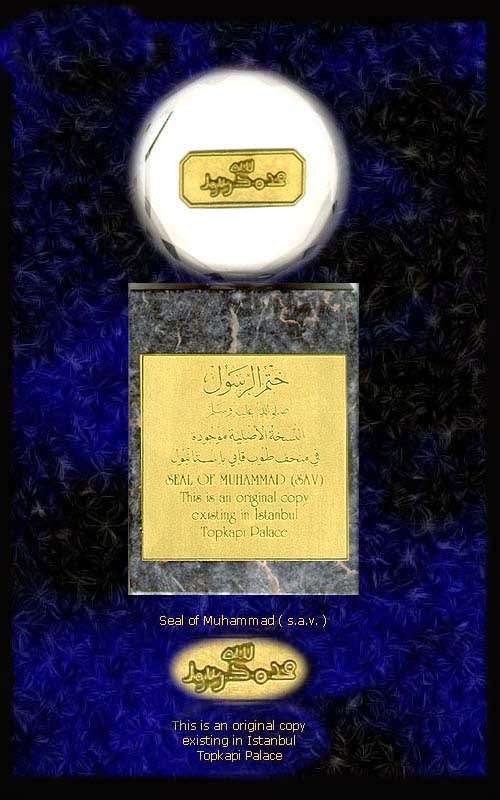
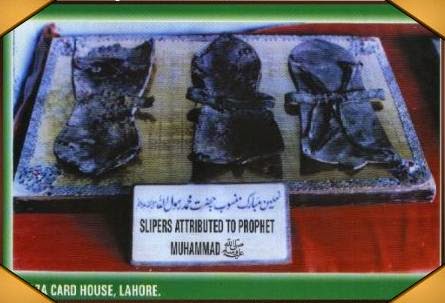
Islam in History: Pictures of Items attributed to Prophet Muhammed (PBUH)
Slippers of Prophet Muhammed (PBUH)
Container for Medication of Prophet Muhammed (PBUH)
Letter of Prophet Muhammed to Nijashi
Footprint of right foot of Prophet Muhammed (PBUH)Swords of Prophet Muhammed (PBUH)
Clothes of Prophet Muhammed (PBUH)
Picture of the remain of the house of Prophet Muhammed (PBUH)
...Wallahu Allam (Allah knows best)
Wednesday, October 15, 2014
Subscribe to:
Posts (Atom)